September 11, 2026 · 6 min read
Cost Was Never the Problem: What Actually Breaks an Offshore Team
Every founder conversation about building a team in Pakistan starts the same way. The appeal is obvious: good people, for a lot less than it would cost at home. That part is true. Cost is real, and it matters.
But after twenty-five years building and running HR and operations teams — across telecom, tech, media, and real estate — cost has never once been the thing that told me whether a team was going to work. The teams that worked and the teams that didn't were usually priced about the same. What separated them was something nobody budgets for: structure.
The Question Founders Actually Need to Ask
When a founder decides whether to build a team in Pakistan, the question they usually ask is some version of "how much will this save me." It's a fair question. It's just not the one that predicts the outcome.
The question that actually predicts the outcome is closer to this: if something goes wrong at 2am their time and 11am mine, who notices first, who decides what to do about it, and how long before the founder even hears about it? Founders who can answer that clearly, even roughly, tend to end up with teams that hold together under pressure. Founders who can't tend to keep managing the same problem on repeat, no matter how talented the people they hired actually are.
Why "They're Just Not Proactive" Is Almost Never the Real Story
I hear this complaint constantly, usually from a founder who's genuinely frustrated with their offshore team. The people aren't proactive. They wait to be told. They don't flag problems early enough.
In nearly every case I've looked at closely, the issue wasn't the people. Nobody had ever defined what "proactive" was supposed to mean for that role, in that business. Nobody had said: here's what counts as a problem worth flagging, here's who you tell, here's how fast, here's what happens if you get the call wrong. Without that, even a genuinely capable person defaults to waiting for instructions — because waiting is the safer choice when the rules were never made clear.
That's not a talent gap. It's a structure gap. It's also easy to miss, because from the founder's side of the screen, it looks exactly like a performance problem.
What Structure Actually Means, in Practice
It's a vague word, so it's worth being specific. In every team I've seen genuinely hold up under pressure, four things were true — and they were true early, not patched in after something broke.
Someone was accountable for outcomes, not just tasks. There's a real difference between "finish this ticket" and "make sure this part of the business keeps running," and a team that only ever hears the first version of that instruction stays dependent on the founder indefinitely.
Decisions had an owner. Not every decision needed the founder's sign-off, and the ones that didn't were written down somewhere, even informally, so the same argument didn't resurface every week.
Communication had a rhythm, not just a channel. A Slack channel, or a Teams channel, is not a communication structure on its own. A short recurring point where status, blockers, and decisions actually surface is.
And someone understood both sides well enough to translate. Not just the work itself, but the gap between how a founder in the US or UK expects a problem to be raised and how it tends to get raised locally by default. Left alone, that gap quietly turns into the founder assuming silence means nothing's wrong — when it usually means something else entirely.
None of this is expensive. None of it shows up on an invoice. That's exactly why it's the first thing skipped, and exactly why skipping it is what ends up costing money later.
What It Costs When Structure Is Missing
The cost of skipping structure doesn't show up as a bad hire. It shows up as the founder's own time. It shows up as being the one person who notices every problem, chases every update, and makes every call — because nobody else was ever given the standing to do it. At that point, the hourly savings from the offshore hire are still real on paper, and almost beside the point, because the thing that was supposed to free up the founder's time has quietly become one more thing consuming it.
I've watched this happen to founders who hired genuinely excellent people. The person was never the issue. The absence of anything around them was.
Where This Needs to Start
None of this has to be figured out after something breaks. It's cheaper, by a wide margin, to decide it before the first hire is even made: who owns what, how decisions get made without the founder in the room, what the first thirty days actually teach someone about how the business runs, and what "flag this immediately" is supposed to mean in practice.
Founders who get this right early didn't do it because they had more time or more money than everyone else. They did it because they treated structure as part of the hire, not as something to sort out later if problems came up.
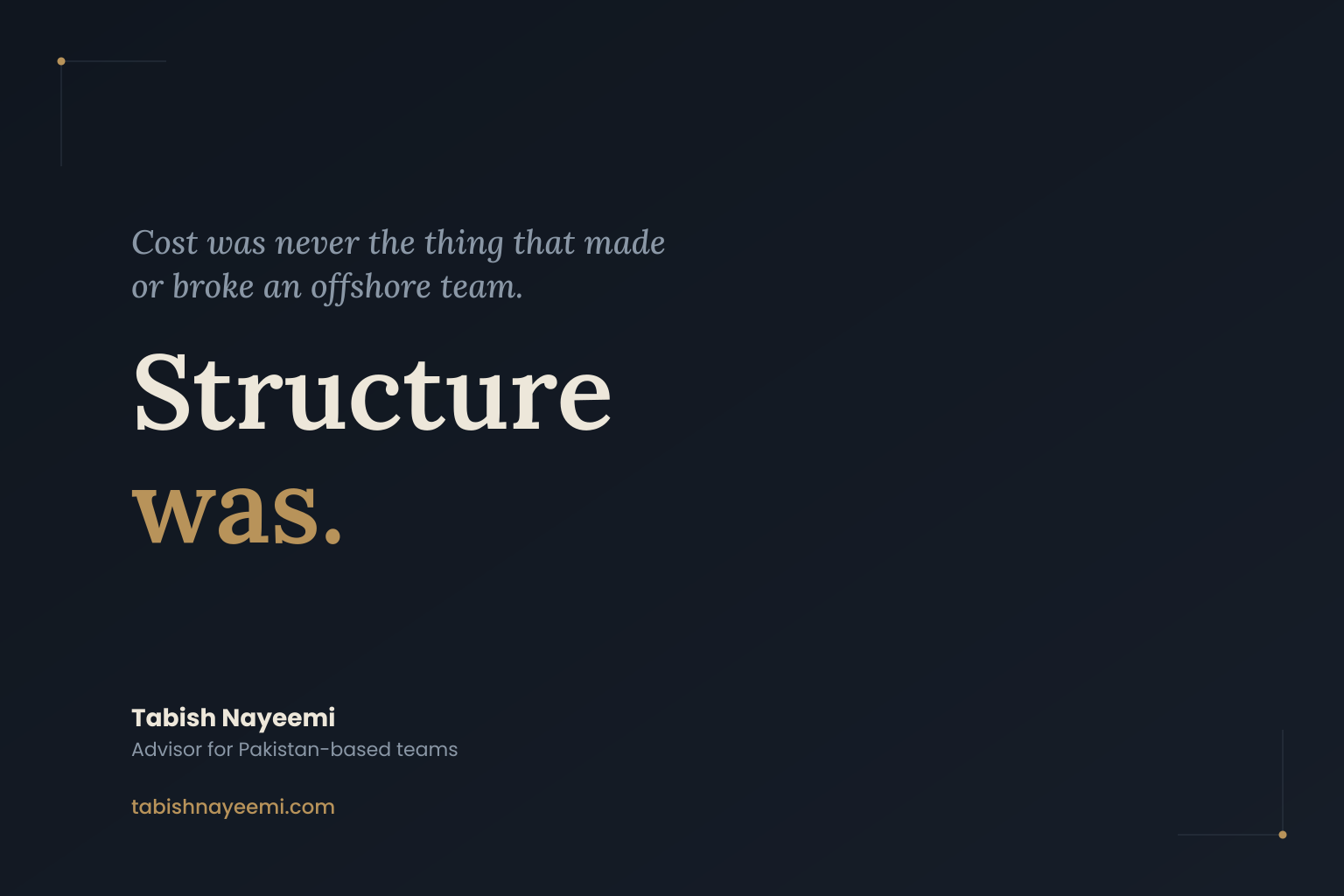
Cost will always be part of the conversation about building a team offshore, and it should be. But it was never the variable that decided whether the team worked. Structure was, every time.

Keep Reading
The Org Chart Mistake Founders Make With Their First Offshore Hire
Founders get the person right more often than you'd think. It's the org chart that goes wrong, and it's the mistake that quietly turns a promising first Pakistan hire into a management headache.
Pakistan's Positioning Problem: Why It Rarely Makes the Hiring Shortlist
Pakistan has the talent to compete with any offshore market. So why does it rarely make the shortlist? A positioning problem, not a talent one.